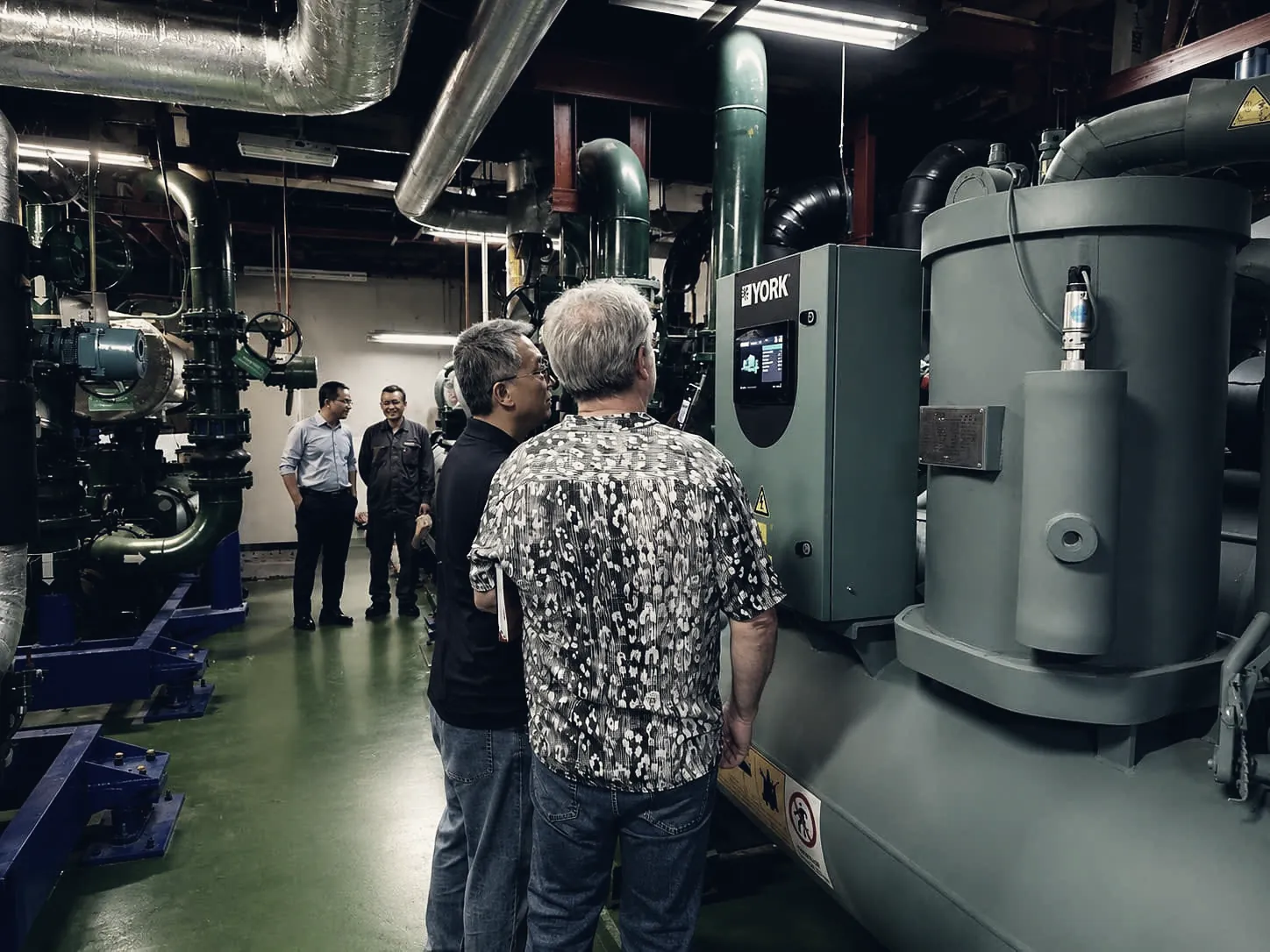



Five-minute data: how we verify every kilowatt-hour saved
DCKV meters every fan it controls every five minutes and compares the readings with a baseline agreed before installation. The monthly saving comes from those readings.
DCKV team

Energy projects have a credibility problem. Savings get quoted from models, the models assume tidy conditions, and a year later nobody can find the saving on the bill. Part of the reason is the meter: a building's main meter mixes the kitchen fans with the chillers, the lifts and the laundry, and a change of a few kilowatts disappears in the noise. DCKV avoids that by measuring the fans themselves.
1. Agree the baseline
Before the system goes live, we meter the existing fans at their normal fixed speed. Fixed-speed fans are predictable: a fan at constant speed draws close to constant power, so the baseline comes down to power multiplied by operating hours. Both sides sign off the baseline before installation.
2. Meter at the drive
Each variable-frequency drive knows how much power it is delivering. The drives report it over Modbus, the industrial protocol most drives support, to a gateway on site. Every five minutes the gateway records each fan's power and speed and sends the readings to the cloud over MQTT, a lightweight messaging protocol built for unreliable connections.
Five minutes is short enough to show every service as a ramp up and a ramp down, and long enough to keep the data manageable. That's 288 readings per drive per day, a little over 105,000 a year.
3. Calculate the saving
For each five-minute interval, the saving is the baseline energy for that interval minus the energy the drive measured:
saving = baseline kW × 5 min − measured kWh
Add up the intervals and you have the day's saving, then the month's.
Two rules keep the comparison fair. When the kitchen is closed, the baseline for that interval is zero, so nobody gets credit for a kitchen that wasn't cooking. When the kitchen changes, with a new shift, a new outlet or longer hours, the baseline is adjusted using the method written into the contract.
This is Option B of IPMVP, the International Performance Measurement and Verification Protocol: isolate the equipment that changed and measure it directly.
4. Report it
The monthly statement turns a month of five-minute readings into a handful of figures.
| Baseline fan energy | 4,440 kWh |
|---|---|
| Measured with DCKV | 2,180 kWh |
| Energy saved | 2,260 kWh 51% |
| Electricity cost saved, at $0.12/kWh | $271 |
| CO₂ avoided, at 0.66 kg/kWh | 1.49 t |
| Intervals received | 8,621 of 8,640 |
Look at the last line as closely as the saving. Gaps happen: a router restarts, a contractor unplugs a gateway during a refit. A good statement shows how many of the month's 8,640 intervals arrived and says how any gap was treated.
What the fan meters don't capture
Fan electricity is the part we meter directly. Slowing the make-up air also means less outside air to cool and dehumidify, and in a tropical climate that saving can be large. Measuring it properly needs metering on the air-handling plant too. Where the air handler isn't metered, the cooling saving should appear on the statement as an estimate, kept apart from the measured fan saving.
From kilowatt-hours to Scope 2
Electricity savings reduce Scope 2 emissions, the emissions from purchased electricity. Because the saving is metered in kilowatt-hours, converting it to CO₂ is one multiplication by the grid emission factor for the country, and the five-minute data sits behind the figure if an auditor asks for it.
More from the blog
- What is demand-controlled kitchen ventilation, and why are hotels switching?Most hotel kitchen exhaust fans run at full speed from the first prep shift to the last clean-down, whatever is on the stove. Demand control slows them down when the cooking eases off, and the electricity bill follows.
- Zero-CAPEX energy upgrades: how shared-savings contracts workPlenty of energy projects with a short payback still stall in the capital budget. A shared-savings contract pays for the system out of the electricity it saves, so the upgrade doesn't have to wait for capital.
- Cutting diesel at mining camps, one exhaust fan at a timeAt a remote camp, the electricity for the kitchen fans comes from diesel generators. Slowing those fans when the cooking stops is one of the simpler ways to burn less fuel.